Friday, August 26, 2011
Monasteries
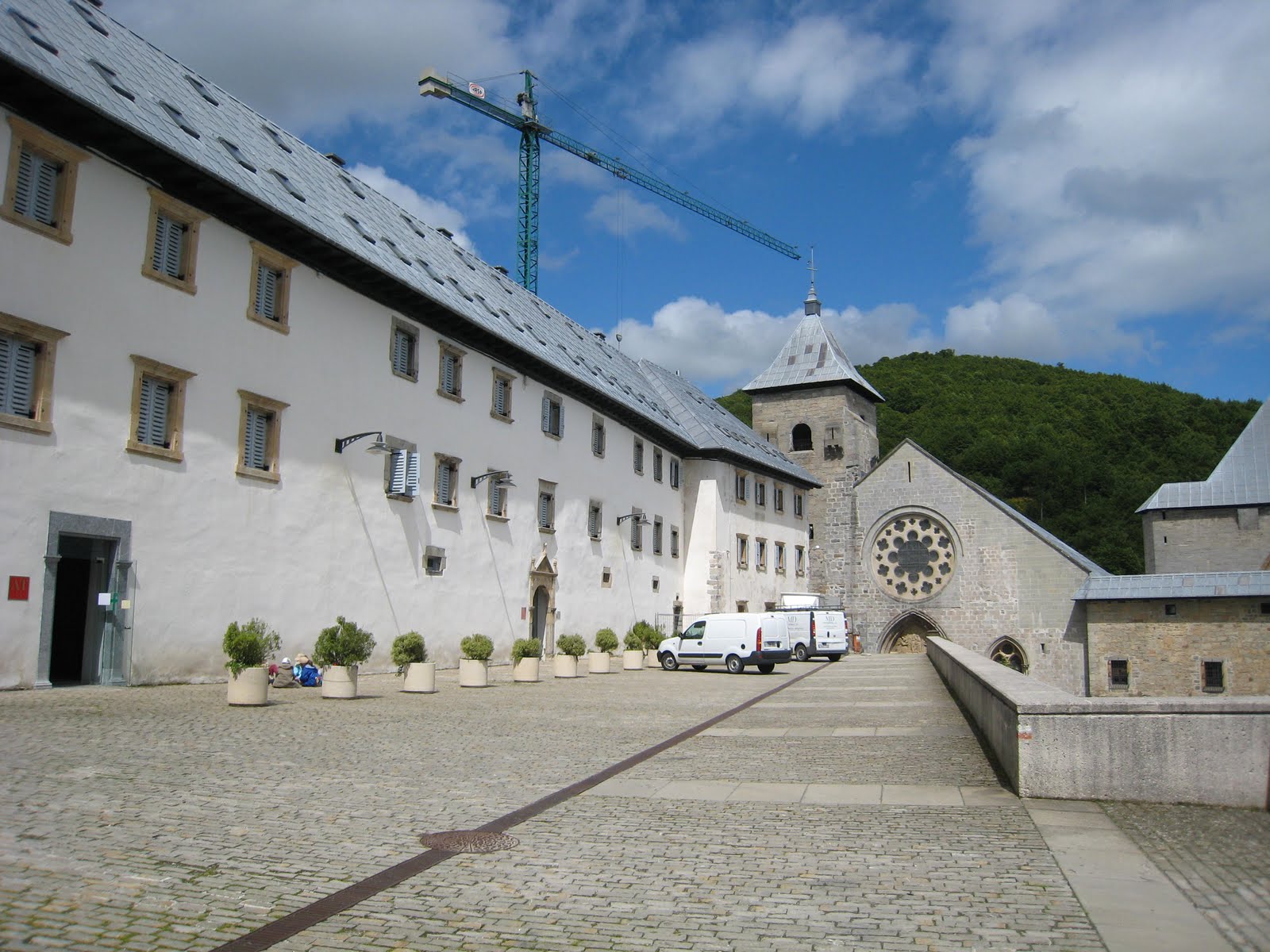
In 2009 we stayed in the Benedictine monastery of Santa Maria Carbajalas in Leon, Spain. It was nice, but our room looked out on the courtyard seen in the foreground, which was the scene of all-night partying by crowds of young people.
Coming into the town of Samos, one gets this view of the Monasterio de Samos. Impressive as the facility is, we'd been warned away from staying there. Peeking into the cramped sleeping rooms, we discovered that we had received good advice.
We stayed in the huge Monasterio de San Martin Pinario in Santiago in 2009. The building covers almost an entire city block, but one day at breakfast we were joined by only four other guests.
Peg lounges in our rather basic room in the Monasterio de San Martin Pinario.
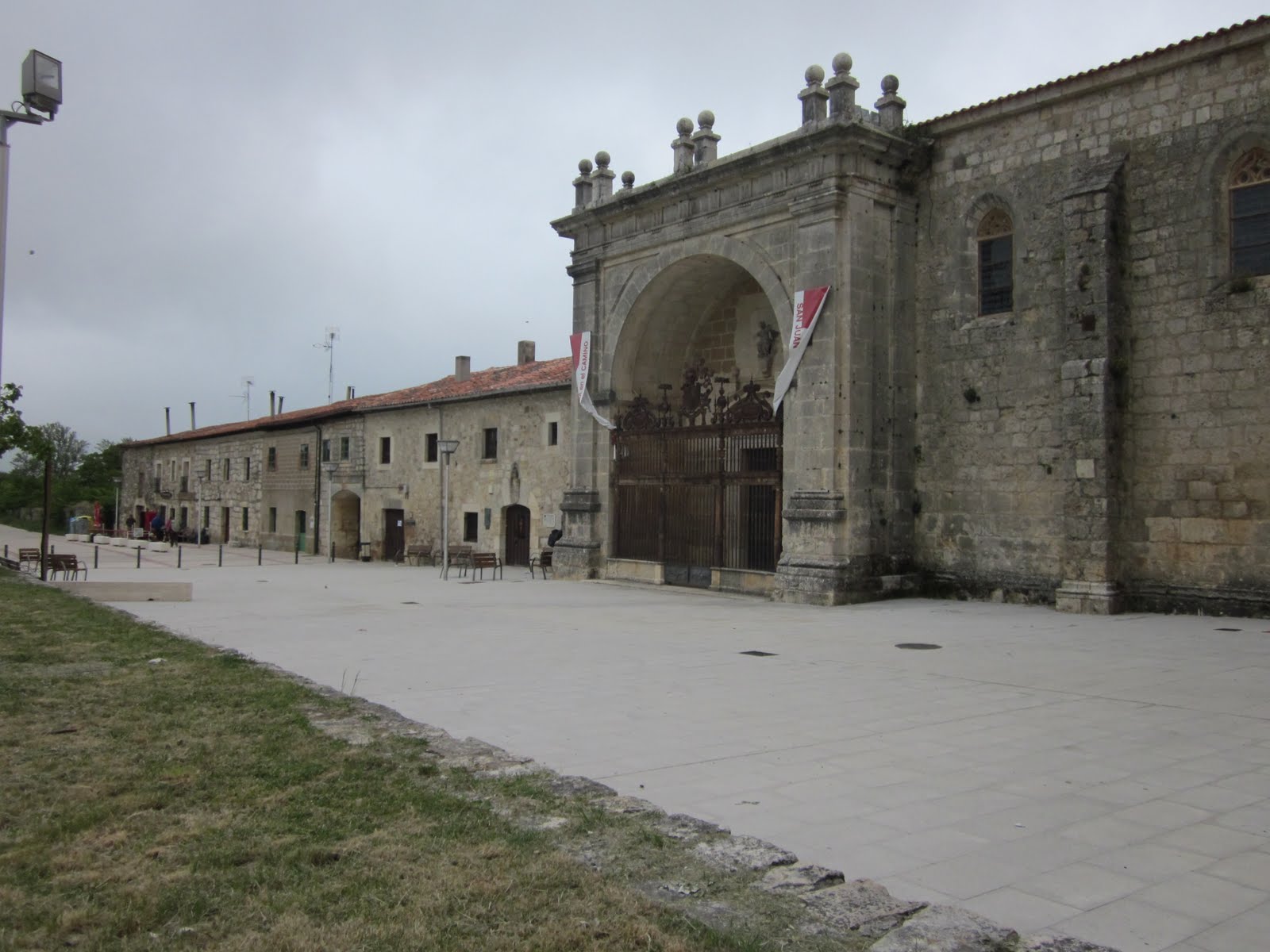
This is the Augustinian monastery of St. Nicholas de Barri in the tiny town of San Juan de Ortega. Built in 1150, it has accommodations for pilgrims. We didn't stay there, but stopped this year for a cup of coffee in the adjoining cafe bar.
All that remains of the Monastery of St. Felix de Oca is this gateway. Founded in the 9th century, it was once an important institution.
These ruins are what's left of the convent of San Anton, near Castrojerez in the Kingdom of Castilla y Leon. The order was famous for curing the disease St. Anthony's fire, now thought to be a form of ergotism, resulting from the eating of moldy bread. These ruins date from the 14th and 15th centuries. Unlikely as it might seem, a small facility tucked into one corner of the ruins was offering lodging for pilgrims when we visited in 2011. We took a pass on the opportunity and opted for more traditional accommodations.
The monastery of St. Zoilo, near the town of Carrion de los Condes now functions as a luxury hotel. Walking by this year we thought we might stop for a cup of coffee, but decided to walk on.
These ruins are nearly all that remains of the once-important Monasterio de San Facundo in Sahagun, Spain. Behind them is a much more modern clock tower. The monastery was founded in the mid 800s, but these ruins may be of more recent structures.
We missed others along the route, some having been reduced to little more than rubble, and many more probably re-purposed. Those that are still active as monasteries or convents are mostly reduced to mere handfuls of occupants.
Monday, May 24, 2010
This Week 2009 and 2010
Sunday, March 21, 2010
Tuesday, June 16, 2009
The Story of La Cruz de Ferro
The Cruz de Ferro was a favorite place on our Camino. It is one of the highest points along the route, so part of being a favorite was knowing that after we reached it, we could stop climbing.
But the story also makes the spot. While walking in the Paramo, the flat, high plains before the mountains, pilgrims traditionally pick up a stone and carry it to the Cruz de Ferro where they leave it behind.
The stone was a symbol of the pilgrim’s sins, or those of someone the pilgrim wanted to help by making the pilgrimage on his behalf. Calvinists argued that only a person, himself, could make amends for his sins, but other Christian traditions said that if Jesus could make up for our sins we ought to be able to help each other out in similar ways. Leaving the stone at the Cruz de Ferro was a sign of leaving behind your bad behaviors and starting a new page.
The stone also came to symbolize the burdens and sorrows of life. Leaving it behind at the Cruz lightens life’s burdens. That’s a symbolism we liked. So we carried stones for ourselves and one for all our friends and left them on the huge pile at the Cruz. You should feel a bit lighter since we were there.
The photos show our two stones and our placing them at the top of the pile.


Monday, June 15, 2009
Leaving the Camino Doesn't Mean the Camino Leaves You


Along the trail.

Baby pilgrims, canine pilgrims, locals, pilgrim friends.


Sunday, June 14, 2009
Some Statistics
We walked on 22 consecutive days, for the relatively modest average of 9.25 miles per day. We had intended to average about 12 miles per day, as we did last year. Once the plane reservations were made, however, the days were available. We decided to fill up our time in Spain with relatively modest walks and ample free time to relax and enjoy the surroundings. We favored this approach over walking longer days and spending the extra days gained by becoming conventional tourists.
Having walked every step of the route, we were curious about how many steps we had taken. Using the stride we had used to calibrate our pedometers, we calculated that each of us had taken approximately 450,000 steps, or about 20,000 steps per day of walking.
What will we do for an encore? We don't know, but may consider another walking vacation in 2010, probably in some other part of the world.
Tuesday, June 9, 2009
Starting Back to Florida
At breakfast this morning at the monastery there were only four places set at the table...200 rooms and four guests. What an intriguing place. We guess that much of the clientele is from retreats and church groups that come to the city.
The breakfast room has long, communal tables and a stairs leading up to a pulpit-like perch overlooking the room. College friends of PegÅ› might be reminded of the dining room at the East Avenue Retreat House, where they made annual, silent, retreat weekends and a nun would read inspirational words from such a perch during meals.
Today at breakfast, we were able to pay for our monastery stay. We asked about paying when we arrived and were told by the woman-who-runs-everything that we could pay whenever we wanted. We tried twice during our stay, but the woman could not be available at those times and she seemed to be to only one who could accept payment. Luckily, she served breakfast today and we could pay as well as tell her how much we enjoyed our stay and her wonderful monastery. What a fantastic, end-of-Camino experience.
We walked to the bus stop and took the bus to the airport. It felt good to walk with our packs. We had a bumpy, short, on-time flight to Madrid and are now in the Madrid Aeropuerto High Tech Hotel, with a laptop and free internet in our room. Combined with fluffy towels...it is hard to imagine more luxury...and a greater contrast with the monastery! Dinner looks like it will offer some new Spanish gourmet choices when the restaurant opens at 8:30...they eat late here.
We leave Spain at 11:30 tomorrow. At 8:00 Peggy is meeting us at the Gainesville airport; she emailed that we have beans and tomatoes in the garden and a big golden dog who is eager to see us. That sounds really nice.
Santiago Rainy Days Continue
We spent a couple of rainy hours in the Cathedral Museum, which was the only of 22 museums open on Mondays. There are several rooms with wall-to-wall, floor-to-ceiling tapestries depicting everyday, medieval life. There were people dancing in the town square, dogs barking, women chasing bad-behaving men out the village gates with brooms, people playing...and cheating...at cards, and a man peeing in the square. If we had to suffer a rainy day in the city, this was not a bad way to spend it.
In the late afternoon, we went back to the cathedral to see it with the interior lights on. The cathedral is awesomely baroque. The evening lights made the gold glitter so powerfully that the edges of the statues seem to blur into each other, as if you were squinting.
There is a glittering, golden statue of St James...Santiago...above the altar. A walkway leads up behind him. Pilgrims walk up and "hug" the back of St James in thanks for the Camino experience. Hundreds file by. We gave the saint a restrained, American pat on the back.
We have generally had good food in Spain, and had one super dinner in Santiago. The first course was a rich-brothed, shellfish soup. The second was snails and clams...both great. We would have had the plate of assorted local cheeses with with currant jelly for dessert, but the other diners had eaten it all up before we got our chance.
Monday, June 8, 2009
Rainy Days in Santiago
One woman seems to run the whole place. She took our phone reservation, showed us to our room, cooked and served the breaskfast, and made up the room. Of course, if that´s true, she doesn´t really want to fill all the rooms.
It has rained constantly since we arrived. Today we had planned to take a bus to Finisterre at the ocean...the énd of the earth.´ It has been a pilgrim destination even for the Romans and ancient peoples because it is the most western spot where the sun sets. We hear it is beautiful. But it is raining so hard that we wouldn´t be able to see anything except the fog on the bus windows and the fog on the ocean when we arrived. So we are doing the few museums that are open on Mondays. The Camino is about accepting the weather and doing what it allows.
Sunday, June 7, 2009
Camino Day 22 to Santiago
We had our best Pilgrim dinner the night before our last day at O Acivro, our delightful, and final, casa rural. The primero course was crepes and the secundo...veal. The chef really knew how to cook and present food...even the creme fraiche with cherries for dessert. Yum as they say in Spanish.
We walked in a heavy downpour twice during the day and arrived in Santiago, 14 or so miles after leaving O Acivro, still in our ponchos. We are staying in a monastery...thank you Phyllis for the recommendation. We got in about 1:00. It is just what a monastery ought to look like...sort of similar to a 60´s dorm. Perfect for transitioning from the Camino to real life again...nice slow changes.
The guide books predicted "hoards" of pilgrims for the final 15 kilometers into Santiago, but they did not materialize in the rain. We saw some students from Ohio, and talked to Irish pilgrims, and met our first canine pilgrim, carrying his water and food in a doggy backpack... but mostly had the trails to ourselves. Initially the trail was in winding eucalyptus woods, then it became more citified as we walked around the airport, under the landing lights, and into the outskirts of Santiago. Still a good walk and we didn´t really mind the rain much.
After resting we went to the official Pilgrim Office and got our certificate of completion...our Compostela. That meant about 30 munites of waiting, but not bad. We wandered around briefly in the rain and then found a local bar to duck into, thinking of Meg and Steve and Prague cold.
A good day, but we are sorry that the walking is over.
Friday, June 5, 2009
Camino Day 21 to Rua
We had no rain until we had arrived and were warmly tucked into the cafe for a late lunch... sandwich, tortilla francesca, and beers.
Our plan is to chat with the other pilgrims, have a pilgrim dinner, and kick back for our last day before reaching the city of Santiago tomorrow afternoon. There is no chance to post photos here. Maybe in Santiago.
Thursday, June 4, 2009
Camino Day 20 to Arzua
Another day of clouds, but not the cold fog so it has been lovely. A bit of sun has broken through now in the afternoon. However tomorrow and the next day are 60 % chance of rain, so our ponchos will be at the ready.
Today´s woods are more eucalyptus and pine, rather than oak and chestnut. The trails are still through woods. There were several rivers so we went down and then up but gently, for the most part. Nine miles today. We had coffee in a town where medieval pilgrims used to bring limestone rocks from the Triacastela quarry to be turned into cement for the building of the cathedral in Santiago.
Second stop was at a beautifully restored 15th Century pilgrim hospital. We had juice and met Belgian pilgrims we´ll meet later today for a drink.
Generally fewer pilgrims. The ebb and flow of the numbers is puzzling.
Camino Day 19 to Melide
Tuesday, June 2, 2009
Camino Day 18 to Palas Do Rei
Bell towers on coutry churches often look like this one...
Crosses mark intersections and important spots along the route...
The door of a particularly pretty little country chapel
Sunday, May 31, 2009
Camino Day 16 to Portomarin
Saturday, May 30, 2009
Camino Day 15 to Morgade
We chatted with a Spanish woman tending her cows. She told us about her church, which we had just visited. It is romanesque and very beautiful in its simplicity. When the Feast of Santiago comes in July, pilgrims come from all over to the church. The alberque isn´t big enough, so they camp in the fields. She loves meeting all the foreigners.
Another woman tried to get Peg to put on long sleeves against the sun. She said her skin was too white and would get ugly and fall off...mostly that was in effective pantomine. She asked if we´d been to Puerto Rico and then showed us how they dance there, twirling Peg around the street while singing. We told her we were from florida and her grandson said...Mickey Mouse, Mickey Mouse! She loved that.
Our Pension in Sarria turned out to be the 3rd floor of an apartment building, Sarria being a pretty big city. Our room was colorful and quiet. Nice.
Morgade is a "town" of ONE house and that is where we are staying. It is a lovely spot in the middle of green fields...lots of nice pilgrims including a 74-year old woman from England who is walking a slightly younger French woman, with the mother of her daughter´s husband. They walking from Normandy...2000 kilometers. The French woman did it alone two years ago!
Happy trails, great views. Wish we could post photos, but we´ve had no opportunity for days and days!